

Key Points
- Shareholder engagement is the work investment managers do to influence company behavior on behalf of the people invested in their funds or separately managed accounts. It happens year-round and largely out of view.
- In this edition: Calvert raised questions with General Motors about Indigenous consent in lithium sourcing. Dimensional voted against three directors at Tredegar Corporation over executive pay, and two of them left the board. Adasina Social Capital advanced an investor campaign to end subminimum wages. As You Sow reached an agreement with Walmart on avocado sourcing and deforestation.
- Engagement can look like a letter, a meeting, a vote, a public campaign, or a proposal withdrawn before it ever reaches a ballot. The instrument depends on the problem.
- Abacus doesn’t manage the underlying funds or separately managed accounts in your portfolio. We select the investment managers who do, using financial criteria alongside our Minimum Societal Values standards, and how those managers engage with companies is part of what we evaluate.
A lithium mine. A shareholder vote on executive pay. The wage paid to a tipped worker. Avocado orchards in Michoacán, Mexico.
These four things have little to do with each other, and all four came up this quarter in the same line of work.
At Abacus Wealth Partners, we believe where your money goes matters, including what it does while it’s invested. Choosing values-aligned investments is one part of that. The other part is quieter and harder to see, and it’s the reason this series exists.
The funds in your Abacus portfolio hold shares in a large number of companies, and those shares carry rights. The right to request a meeting with company leadership. The right to vote at annual meetings, including on who sits on the board. The right to file a formal proposal for other shareholders to consider.
You don’t exercise those rights yourself, the investment managers we select do, and they use those rights on behalf of everyone invested in them.
The four stories below are four different uses of those rights.
Not all of them have endings yet. Two are commitments actively being tracked, one is a campaign currently underway, and one has a result we can be proud of.
What is Shareholder Engagement?
Shareholder engagement, also called active ownership, is work investors in public markets do that seeks to influence company behavior.
In a portfolio built from mutual funds and exchange-traded funds (ETFs), investment managers hold company shares through the funds you’re invested in. In a separately managed account (SMA), on the other hand, you as the investor hold the shares directly. That ownership, in either structure, gives the holder a seat at the table. It allows the shareholder to open formal dialogue with company leadership, to vote at annual meetings, to file or support shareholder resolutions, and to escalate pressure when a company falls short of its commitments.
Depending on your Abacus portfolio, this work touches a large number of underlying companies, and it happens mostly behind the scenes. These stories pull back the curtain.
For some clients who are in our Custom Values portfolio, shareholder engagement is even more customized and direct. Clients in this SMA portfolio are able to draw upon our partnership with As You Sow, a nonprofit shareholder advocacy organization that files resolutions and negotiates directly with companies. Clients in this portfolio can opt to lend their shares to support shareholder proposals on values-aligned topics. The Walmart story below shows what that looks like in practice.
Not sure which portfolio you’re invested in? Reach out to your Abacus advisor and they’ll be happy to walk you through it. No matter the portfolio, and even if you are not an Abacus client, we encourage you to read all the stories below, since the work across them reflects the same underlying idea of working to effect positive change on the world through your investment portfolio.
The Abacus ESG Stock Model Portfolio
The Impact on People in the EV battery Supply Chain
Nowadays we’re used to seeing electric cars at a charging station, plugged in outside a grocery store or a gas station. Well inside that car is a very high-tech battery, and inside that battery are minerals that came from the Earth.
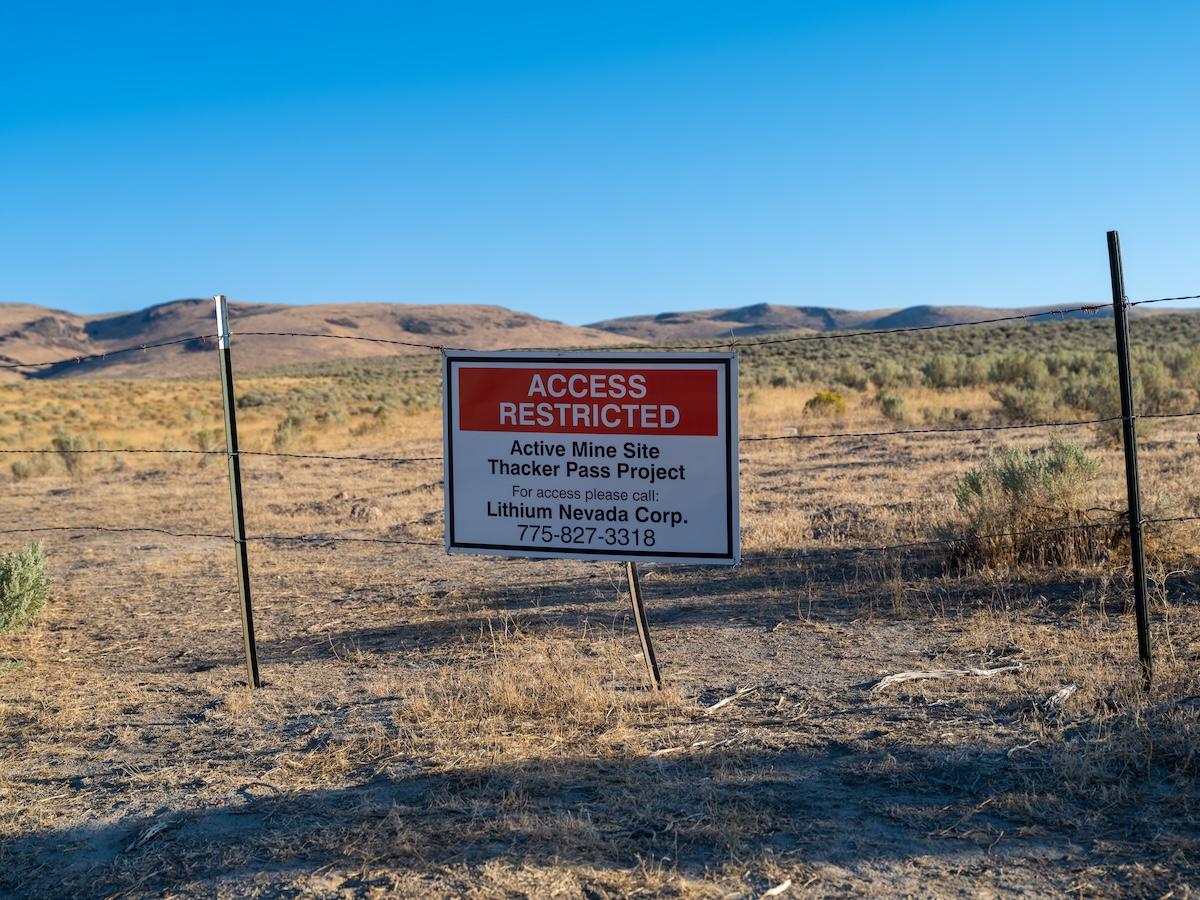
General Motors (GM), one of the companies held in the Abacus ESG Stock Model Portfolio, is building its battery supply chain in North America. Part of that strategy runs through the Thacker Pass lithium mine, a project owned by Lithium Americas Corp, in Humboldt County, Nevada.
The project has met resistance from some Indigenous tribes in the area, who state that Thacker pass is a sacred site and a massacre site, and that they weren’t adequately consulted by the Bureau of Land Management (BLM).
That resistance points to a tension the clean energy transition can’t avoid. The minerals it needs often come from places with history, and how the people connected to those places are consulted matters.
International human rights work has a framework for navigating this. It’s called FPIC which stands for free, prior and informed consent. It centers on obtaining consent from Indigenous peoples before activities go forward on their land. Calvert, one of the investment managers used in the Abacus ESG Stock Model Portfolio, pays close attention to this. They note that EV battery minerals in North America are often sourced from Indigenous lands, which makes FPIC an issue for automakers and mining companies alike. Calvert’s human rights engagement work looks at how companies manage their impact on people across operations and supply chains, with recent focus on EV mineral supply chains.
So Calvert’s engagement team brought their questions directly to both GM and Lithium Americas. They asked how FPIC was being handled with Indigenous communities connected to Thacker Pass.
According to Calvert, GM responded constructively. The company committed to strengthening its FPIC oversight and to working with Lithium Americas on issues at the project, including improving its human rights policies, its supply chain oversight, and what it discloses publicly.
This summer Calvert voted for a shareholder proposal written by a group of Catholic nuns, tribal descendants, and large pension funds. This proposal asked GM to report on whether it respects the rights of Indigenous Peoples, including at its Thacker Pass lithium mine. Calvert’s vote went against GM’s leaders, who had urged shareholders to vote no.
The stakes reach beyond one mine. Thacker Pass is one of many places where the clean energy transition and Indigenous lands meet.
Courts are increasingly enforcing Indigenous rights, and international standards continue to be adopted. Calvert has said it sees a role for itself in helping companies improve how consent is sought and overseen as those expectations shift.
Your investment in this portfolio is part of what gets that question in the room. Not just for shareholders. For the communities living closest to the answer, and for all of us.
The Abacus Sustainable Stock Model Portfolio
When a Vote is More Than a Suggestion
At many corporate companies, a small group of people decide how much the top executives should be paid, and what they would have to accomplish to earn it.
Decisions like that happen throughout the year at many public companies, including the ones inside the Abacus Sustainable Stock Model Portfolio.
One of those companies is Tredegar Corporation, a manufacturer of aluminum extrusions and plastic films. Each year, its shareholders get an advisory vote on executive pay, known as Say-on-Pay. For two years running, that vote came back weak with about 60% in support one year then 57% the next.
For context, Say-on-Pay proposals typically pass comfortably. Average support across Russell 3000 companies was about 92.1% in 2026, according to compensation consulting firm Semler Brossy. A result in the 50% range clears the bar but sits far below the norm, and it tells a board that a large share of its owners have reservations.
Because Say-on-Pay is advisory, a weak result doesn’t require a board to do anything. Whether the message gets acted on depends entirely on how seriously the board takes it, and on whether shareholders are willing to follow up.
Dimensional, one of the investment managers we use in the Sustainable Model Portfolio, treats executive compensation as an ongoing stewardship priority. In their view, pay should be clearly tied to how the company actually performs, so that the people running it and the people who own it are pulling in the same direction.
Looking at Tredegar’s plan, Dimensional saw features it considers below best practice. So in May 2026, ahead of the company’s annual meeting, Dimensional engaged with Tredegar to discuss.
Dimensional concluded the company hadn’t shown enough responsiveness to what shareholders had already told it twice. At the annual meeting, Dimensional voted against the Say-on-Pay proposal, which passed with 56.9% support, essentially unchanged.
Then it went further. Consistent with its practice of escalating persistent pay concerns, Dimensional voted against all three sitting members of the compensation committee who were up for re-election.
This is where a vote stops being a suggestion because, unlike Say-on-Pay, a director election is binding. Two of the three compensation committee members failed to win majority support and resigned from the board.
Two years of advisory votes had left the pay plan largely in place. One round of director votes changed who would be reviewing it.
Your investment in this portfolio is part of what stood behind those votes. Ownership comes with a voice, and this is one example of how it can be used.
The Abacus Social Justice Stock Model Portfolio
When a Tip is Covering for Subminimum Wage
Tipping is one of the few things in American life almost everyone has an opinion about. Is 20% the agreed upon norm? Should tipping be the customer’s responsibility in the first place?
For a lot of workers in this country, a tip isn’t a bonus sitting on top of a wage. It’s a large part of the wage itself.
The part that gets less attention is what the tip is legally permitted to replace. Federal law allows employers to pay certain workers below the standard minimum wage, on the assumption that tips will make up the difference. The practice is called the subminimum wage, and it also extends to some younger workers and to workers with disabilities.
It’s entirely legal. Which makes it a harder problem than most, because no rule is being broken and there’s no single company to hold responsible.
Adasina Social Capital, one of the asset managers in our Social Justice Model Portfolio, takes an unusual approach to these types of issues.
Rather than focusing on one company at a time, Adasina builds what they call investor mobilization campaigns aimed at changing the system. Each campaign is developed with social justice partners and designed to inform, mobilize, and support investors. Adasina describes the strategy as community-centric, informed by the people most directly affected by the injustice, and built to work at the scale of the market.
One of those campaigns is focused on ending the subminimum wage. Adasina’s stated position is that every worker in the US should be paid a livable, fair minimum wage by their employer, and that companies which rely on subminimum wages take on real risk, to their workers, their reputation, and in Adasina’s view their long-term value. The campaign includes a public investor dataset and an investor statement that others can sign.
In June, Adasina signed onto an investor statement sponsored by the Platform for Living Wage Financials, backing its call for multinational corporations to commit to paying living wages throughout their global supply chains. The statement and its supporters were announced at the IDH Living Wage Summit in Rotterdam on June 30.
A single signature on a letter is a modest thing. The point of a coalition is that it isn’t a single signature.
Separately, legislation introduced in Congress in June would, among many other things, phase out subminimum wages for tipped workers, younger workers, and workers with disabilities. Whether it advances is an open question.
That’s the difference between a practice being legal and a practice being settled.
Your money isn’t sitting quietly while this gets argued about. It’s supporting the campaign asking the questions and pushing for long-term change.
Abacus Custom Values Portfolio
The win for Avocados and the Mexican Forest
Some shareholder victories don’t look like victories. They look like a proposal quietly disappearing from the ballot before anyone gets to vote on it.
To understand why that can be a good sign, it helps to know who was behind the proposal.
The Abacus Custom Values Portfolio option is for clients who want to tailor their portfolio to reflect their specific set of personal societal values. We partner with As You Sow, a shareholder advocacy nonprofit founded in 1992. As You Sow leads campaigns that seek to press company management on environmental and social practices, largely by filing shareholder resolutions and meeting directly with executives.
Late last year, one of those resolutions was aimed at Walmart, and the subject was avocados.
Avocado supply to the United States is concentrated in a way most shoppers never think about. Michoacán is one of only two Mexican states cleared by the USDA to export avocados to the US, and Mexico supplies the large majority of the fresh avocados Americans buy.
Growing demand has been linked to illegal deforestation, as forest is cleared to make room for orchards. As You Sow’s concern was what Walmart (a major avocado buyer) knew about the land behind its supply.
There is a voluntary certification meant to address this, called ProForest Avocado, which verifies that fruit isn’t coming from recently cleared forest. The question As You Sow raised was straightforward. “What about the suppliers who aren’t certified?”
Rather than take the proposal to a shareholder vote, Walmart negotiated before the ballot could be proposed.
According to As You Sow’s withdrawal summary, Walmart agreed to engage its Michoacán avocado suppliers not yet covered by ProForest Avocado certification and encourage them to pursue it. Walmart also agreed to keep meeting with As You Sow to report on progress, with a further dialogue planned for later this year.
That’s why the proposal came off the ballot. As You Sow withdrew it, because it had gotten more from the conversation than a vote was likely to deliver.
The work isn’t finished. As You Sow’s biodiversity program is preparing a scorecard with the Center for Biological Diversity that grades retailers on their avocado supply chains, and it intends to keep pressing on the value of the voluntary certification.
A shareholder proposal is a small instrument. One nonprofit, one proposal, one crop, one state in Mexico. That’s what change can look like up close.
Frequently Asked Questions
An investment manager, sometimes called an asset manager or fund manager, is the firm or team responsible for the day-to-day decisions within a specific investment fund, like an ETF or mutual fund. They decide which securities the fund holds, monitor performance, and engage directly with the companies in the fund on issues like climate risk.
Abacus Wealth Partners doesn’t manage these underlying funds ourselves. Instead, we select the asset managers whose funds align with your financial goals and your values, then build and monitor your portfolio around them. When you hear us talk about “engagement,” we’re describing the work these asset managers do on your behalf, using their influence as shareholders to push portfolio companies toward more responsible practices.
Kate Barron-Alicante is the Director of Impact at Abacus Wealth Partners, where she leads the firm’s shareholder engagement, impact reporting, advocacy, and strategic partnerships across an over $3 billion investment advisory practice. She has served on the Abacus Board of Directors and has been with the firm since 2017.
As a CERTIFIED FINANCIAL PLANNER® professional, Kate works directly with impact-driven clients, helping them connect their passion for systems change with their approach to investing, giving, and wealth. Before joining financial services, she spent more than fifteen years working in social impact, community development, and international development, and holds a Master of Science in International Development from the University of London’s School of Oriental and African Studies.


